
27th November - 6th December 2026
9:00 - 21:00
House of Croatian Defenders
Leharova 1, Pula
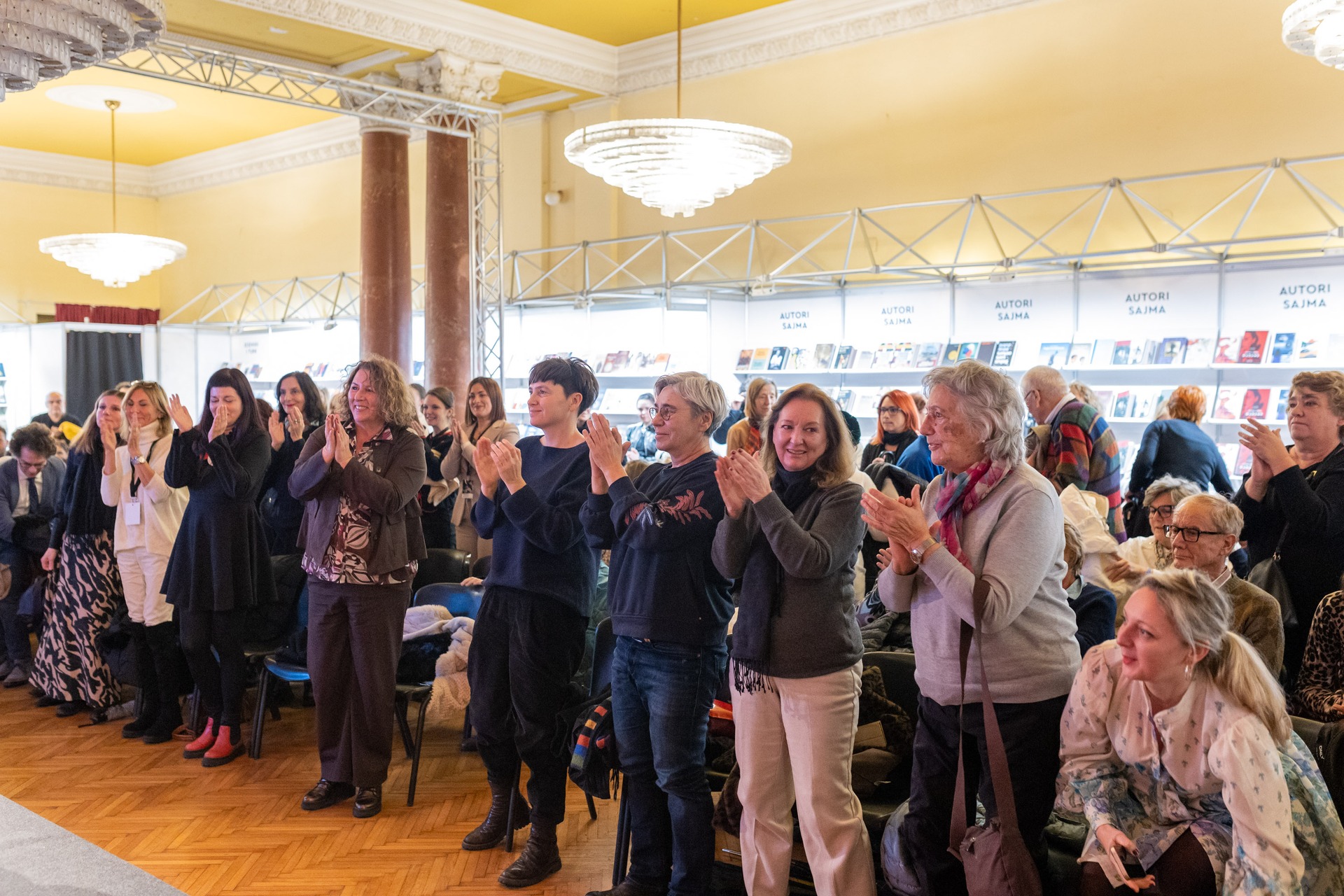
“An explosion of culture and literature marked the 1950s and 1960s. These were the years when Italy broke free from its long tradition of fascism and censorship, when even Kafka’s books and the works of Dostoevsky were unwelcome. These were also the years when these authors regained their place in the literary canon. Many important writers entered the literary scene then – Elsa Morante, Alberto Moravia, Pier Paolo Pasolini, Giorgio Bassani, Italo Calvino, Leonardo Sciascia, Carlo Emilio Gadda… I am happy to have known and lived alongside the greatest writers and poets”, said Dacia Maraini, a legend of the Italian and European cultural, literary, and intellectual scene, during the Breakfast with the Author on Friday, 5 December, the eighth day of the 31st Book Fair(y) in Istria, led by Aljoša Pužar. Apart from Dacia Maraini’s lifelong commitment to the ideas of freedom and nonconformity, as well as due to her simplicity, humanity, and poetic storytelling, this second visit by this famous author to the Pula Book Fair(y) will also be remembered for the audience’s powerful emotional response. In a gesture of gratitude, the audience gave her the longest and most heartfelt round of applause in the Fair’s history.
“They say we fall in love with people who are good at doing things we love”, responded Dacia Maraini when asked about her relationship with Alberto Moravia, her partner for more than 20 years with whom she was deeply in love. She added that Moravia was a wonderful writer with an exceptional gift for storytelling. He had no desire to teach, but he loved to listen, and was also interested in feminism. “It was a time of great euphoria and creativity, whereas today we live in the age of regression”, Maraini concluded. Dacia Maraini, an artist and one of the most powerful European voices in the feminist movement, spoke about establishing Teatro della Maddalena, a women-run theatre dedicated to their creative work. She highlighted its importance as a space that gave women a voice on stage, brought female characters to the fore, and shed light on the injustices women had endured throughout the centuries. “Teatro is symbolic. It is directly connected to human beings, through it we explore the mysteries of life, death, and the divine, unlike the novel, which is more closely tied to society”, said Dacia Maraini, among other things.
The book Stari Šibenik: kalama, skalama i butama (AGM) by Milivoj Zenić was presented in Histrokozmos’s programme Droplet in Stone. Participants Zdenka Bilušić and Kruno Lokotar, together with host Emir Imamović Pirke, spoke about Milivoj Zelić, a beacon of Šibenik’s cultural life and an exceptionally humble man. The legendary librarian played a pivotal role in the opening of Šibenik’s new library in 2005, then the most modern in Croatia. The winemaker Filip Baraka from Baraka Winery was featured in the programme, while Juraj Sladić, a Šibenik-based winemaker from Testament Winery, presented his wines as part of the programme Wine Tales later that afternoon, together with sommeliers from the Croatian Sommelier Club and the outstanding host Jan Franjul.
The audience also gathered in large numbers for the presentation of Goran Vojnović’s essay collection Skupljač strahova (Telegram), featured in the programmes Disquiets and Ljubljana Reads. Pula, after all, holds a special place in the author’s life. “Skupljač strahova is like an extended essayistic novel. All of Goran Vojnović’s novels are rooted in his personal experiences; the regions and neighbourhoods where he grew up are scattered throughout. I see this book as a meta-novel that explains what Goran wanted to convey in the novels he has written so far”, said Aljoša Pužar. He highlighted Vojnović’s powerful opening story about his great-grandfather, Leon Obleščuk, who came to Bosnia from Galicia at the age of five. Ten years ago, the author used this story as the basis for an absurdist tale, which has become reality today. This also holds true for the essay on Edvard Kocbeck, the great poet, writer, essayist, and political activist who fit into no established narrative. Vojnović opens the essay by asking why someone felt the need to dress a monument after a hat and scarf were placed on the bust of Kocbek in Ljubljana. Reflecting on the story, he remarked: “Anyone writing today would like to see themselves in Kocbek and to be in a position where they do not have to take anyone’s side.” He continued by saying: “Those whose side you take are not without fault. Things are often complex, and drawing a line is not easy. Literature’s task is to question that ambiguity, especially today, when there are hardly any questions left, only answers, each shorter than the last, until they begin to sound like slogans.”
“Historians are constantly discovering new things, and new perspectives are emerging. The fact that we refuse to let history be rewritten does not mean that history itself is set in stone. This opens up extraordinary possibilities for literature. There are always new stories to be told, even about the things we thought had already been thoroughly recounted. When I write essays, I also make things up, I tell a story. It is my perspective. Everyone is entitled to their own perspective, but we must allow and understand that it is not the only perspective”, Vojnović said. The novel Madame (Fraktura) by Antoni Libera, the Polish writer, translator, theatre director, and connoisseur of Samuel Beckett, was presented within the programme Slavic Garden. Dalibor Blažina, the novel’s translator, explained that the book belongs to a very high literary tradition and is exceptionally popular in Poland, where nearly 200,000 copies of the book have been sold and five editions have been published. “Antoni Libera’s entry into literature began with Samuel Beckett. Madame is a great novel related to Beckett, even though it has nothing to do with him directly, and between Beckett and Madame lies an immense body of translation work”, Blažina said. Ivana Peruško, the programme’s moderator and creator, noted that Madame is an incredibly well-written novel, highly readable yet also a treasure trove of world literature, as well as a parody of the coming-of-age narrative. “It is a coming-of-age novel, a Bildungsroman rooted in the German and English literary traditions. It is not my novel; it is my narrator’s novel. In that sense, my narrator is initially a young man attending secondary school, and it is only at the end that we discover that the entire text is a novel he intends to publish in exile. This is no coincidence. It is a deliberate choice made in advance: the narrator is going to write a novel. By the end, the reader has every right to wonder: Did any of the described events actually happen? Is it a fact or fiction? You may consider my narrator a postmodernist, but I do not consider myself one”, Libera said.
The Red Salon was also packed for the presentation of Miccia corta (Milieu) by Sergio Segio, who was born in Pula in 1955 and moved to Milan in his early childhood. A writer, journalist, researcher, and activist, Segio is now an advocate for global rights, better prison conditions, and human rights in general. In his youth, he was a member of Prima Linea, a far-left organisation, which is why he spent 20 years in prison. The conversation that was part of the programme Disquiets, was moderated by Andrea Matošević, with Marian Barbić Poropat providing the translation. “I have visited Pula several times, but only this time have I returned as a man from Pula, and that fills me with particularly strong emotions. I would therefore like to extend my special thanks to Magdalena Vodopija, the Fair’s director, and the entire Fair team. They are doing important work in the field of culture, which is especially vital today, when the world is awash with hatred and weapons”, Sergio Segio said at the beginning of one hour-long conversation, which he concluded by introducing himself as a poet. Segio spoke with great analytical insight about the personal, family, social, historical, and political disquiet that shaped his life, the disquiet which he both witnessed and played a part in. He focused in particular on Italy’s Years of Lead, a turbulent period spanning the late 1960s and the first half of the 1970s, marked by social movements, protests, ideologically diverse forms of violence, left- and right-wing radicalism, and state repression.
“As a fifteen-year-old in Milan, I was tear-gassed and beaten with police batons. These experiences also contributed to my decision to take up armed struggle, a choice I can now say was counterproductive”, Sergio Segio said, among other things, while emphasising the dystopian reality we live in today. “The present is bleak, but we cannot turn a blind eye to it. We must carry culture forward and engage in research, and, above all, encourage young people to do the same, so that the current system can be brought to a permanent halt.”
